Youth Forum

Meeting on the first Saturday of every month, 10:00–12:00, it is a welcoming space where young people can explore fascinating topics, meet experts, handle objects, ask difficult questions, and get to know others who share their curiosity.

No two sessions are exactly the same. Some months are shaped by the interests and questions of regular attendees; other months feature researchers, museum staff, and guest speakers sharing their own work and passions.

Youth Forum is flexible by design. Members join through a regular mailing list and can come along when they are able, making it easy to fit around school, college, and exam seasons. For some, it is a place to deepen their scientific interests; for others, it is a chance to unwind, meet like-minded people, and spend time in an inspiring environment.

More than just a monthly session, Youth Forum is an active community. It often connects young people with wider museum opportunities, including consultations, youth voice projects, and other public-facing programmes. It is a place where participants do not just learn from the museum, they help shape it too. To find out more or join the mailing list, email education@oum.ox.ac.uk.
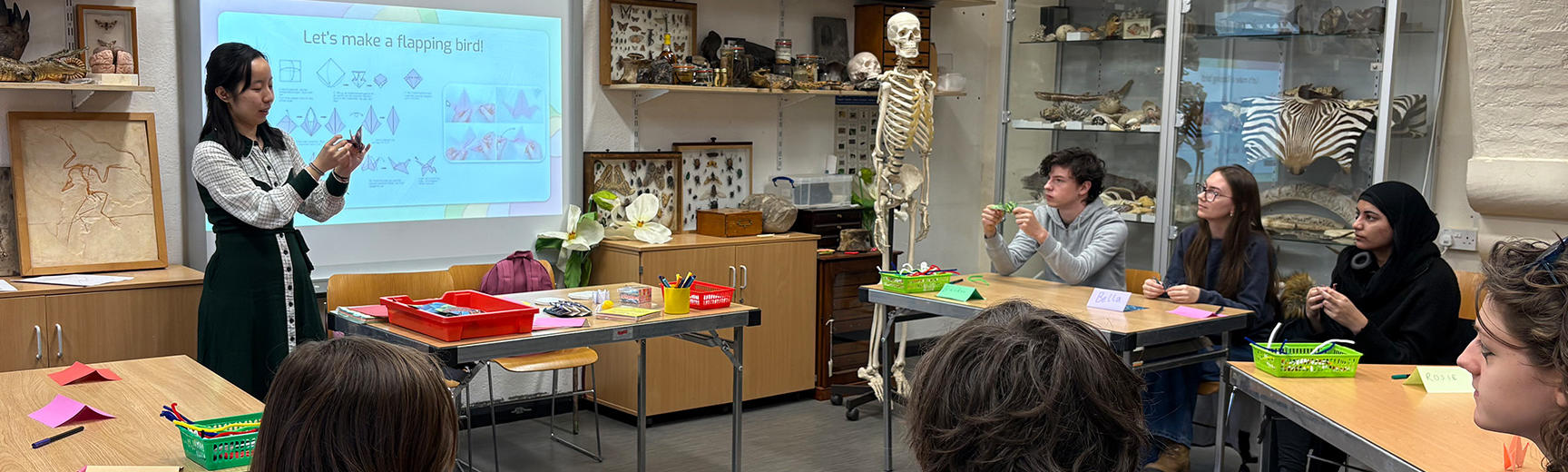
A student sits at a table while another person leans over to help them assemble a small craft using paper, scissors, and colourful pipe cleaners, with more students working in the background.
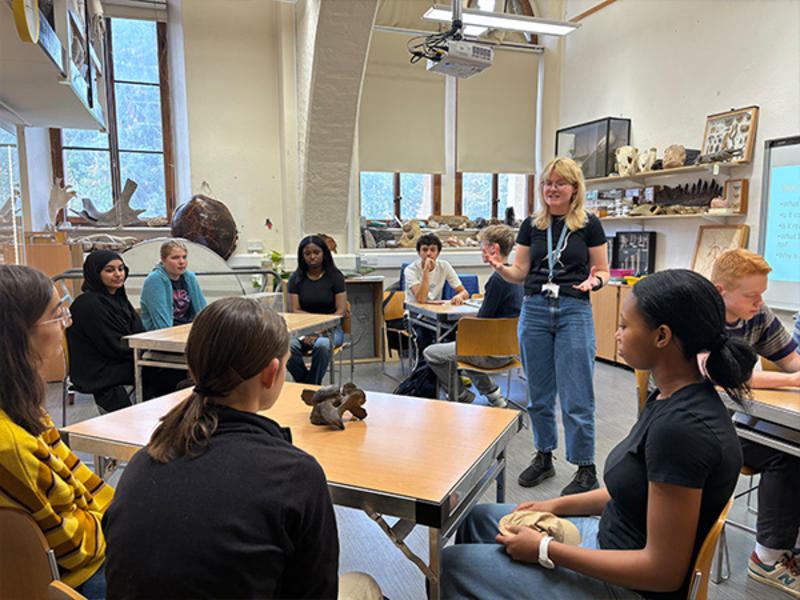
A teacher stands and gestures while speaking to a group of students seated in a classroom, with natural history specimens and large windows visible behind them.


In 2025, topics included:

  • January — Devika: Who Determines Natural History?
    Power Dynamics A session exploring who gets to shape natural history knowledge, whose voices are centered, and how power influences science and museums.
  • February — Himal Govind: Fiji Banded Iguanas 
    A zoology-focused session on Fiji banded iguanas, with activities on studying live specimens and the tools researchers use.
  • March — Dr Leanne Melbourne: Environmental Change and Marine Life 
    An introduction to how museum and fossil collections can reveal the long-term effects of environmental change on marine organisms and ecosystems.
  • April — Devika: Ethics in Science 
    A discussion-based session inviting participants to think through real ethical dilemmas and questions that shape scientific research.
  • May — Katarina Almeida Warren: Chimpanzees 
    A closer look at chimpanzees, our shared evolutionary history, and what studying them can teach us about ourselves.
  • June — Dr Ellen Dyer: Climate Change and Futureproofing
    A session on climate systems, adaptation, and how we can think creatively about responding to long-term environmental change.
  • July — Sarah Lloyd and Devika: Nature and Inspiration
    A creative exploration of how the natural world has inspired artists, writers, and scientists across time.
  • August — Dr Asia Hoile: What Is a Species?
    A hands-on evolutionary biology session examining how scientists define species, from Darwin to DNA sequencing and beyond.
  • September — Maya Lucas: Breaking Ground and Cast Making
    A fossil-focused session linked to the Breaking Ground exhibition, ending with a practical cast-making activity.
  • October — Dr Ellen Baker: Taxonomy
    An introduction to taxonomy through insect research, with room to build on participants’ own ideas and questions.
  • November — Dr Carl Harrington and Maya Lucas: Discovering the Jurassic Seas & Museum Treasures
    A two part session on plesiosaur discovery, Jurassic fossils, and stories from the museum’s collections.
  • December — Dr Chenying Liu: Origami and Robots
    A session linking mathematics, origami, and robotics to show how scientific ideas can connect across disciplines.